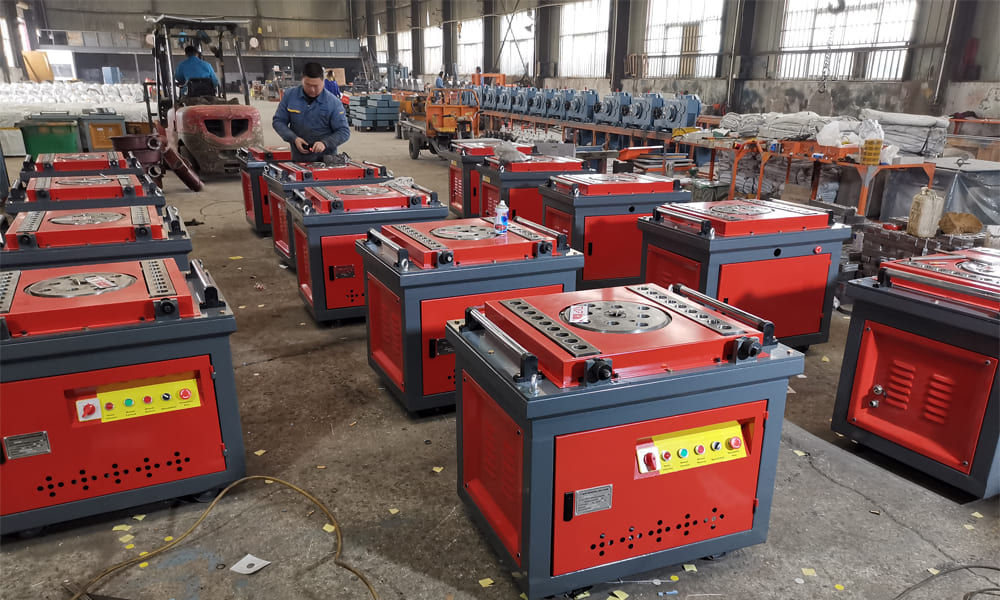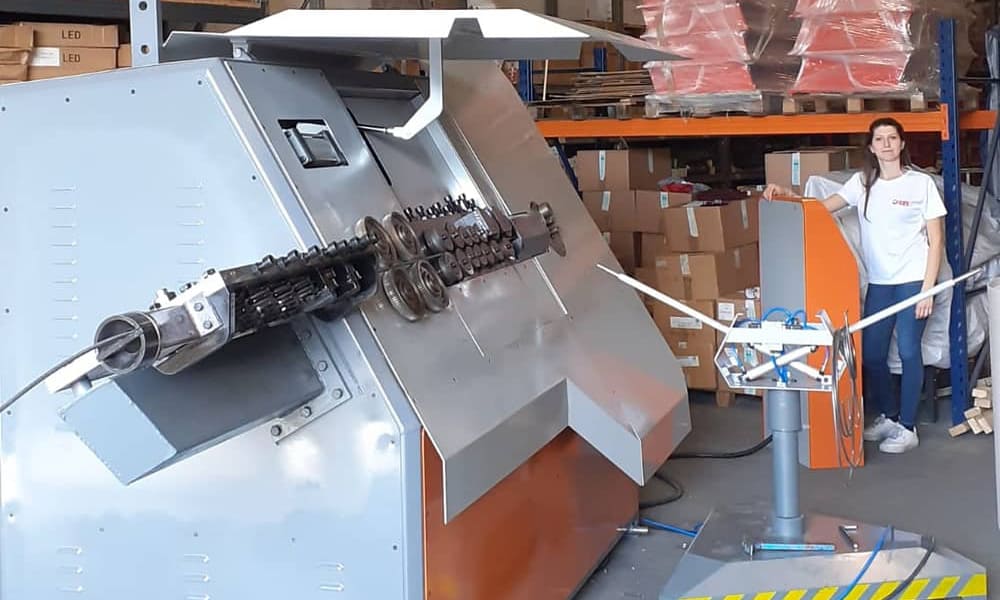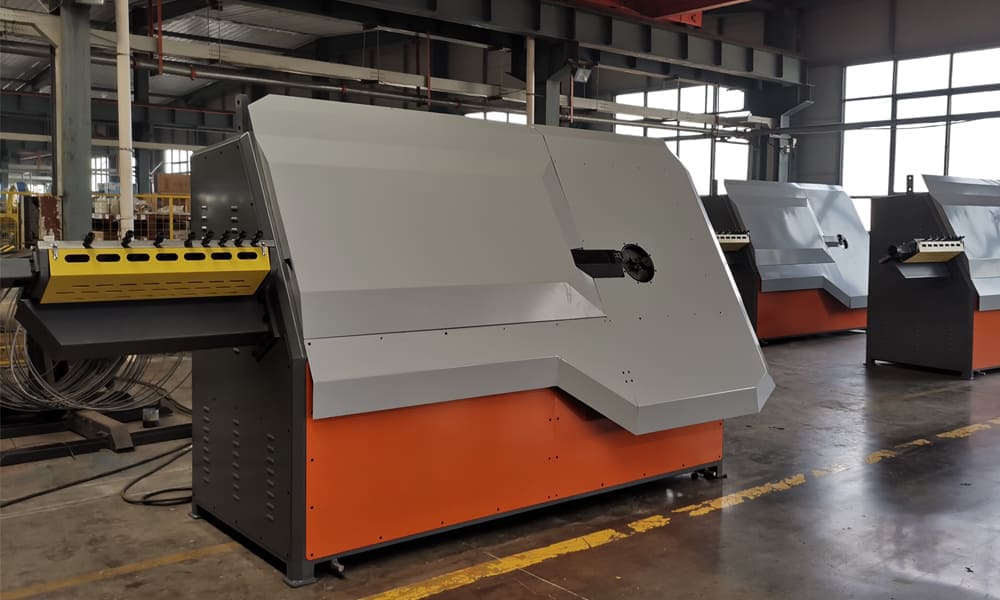
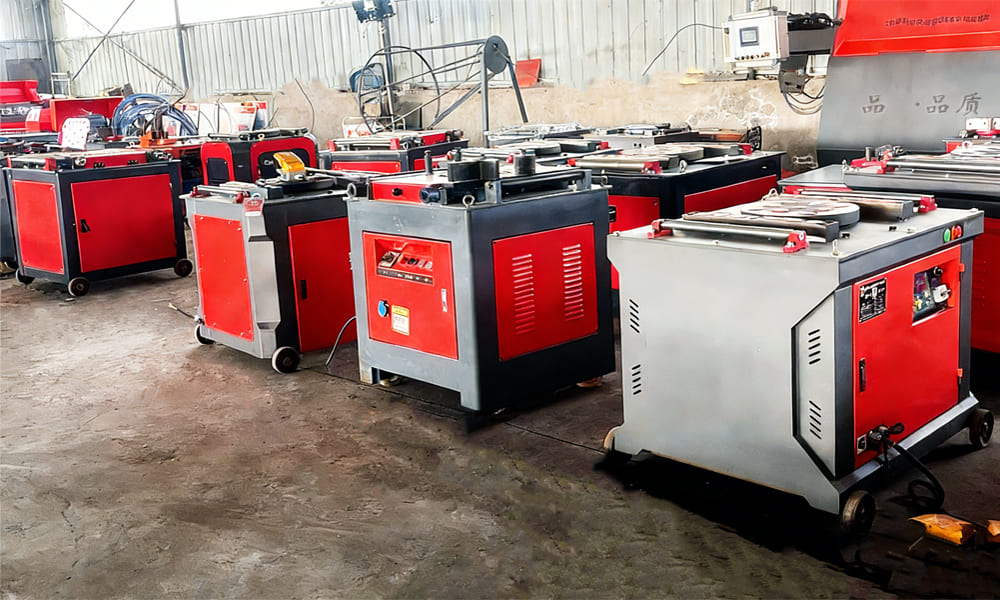
For P52 Rebar Bending Machine, bending angle control is a core technology that directly affects the processing quality of steel bars and the adaptability of construction scenarios. This section focuses on comparing the advantages and disadvantages between the traditional mechanical baffle (mechanical limit) and the intelligent electronic sensor control system, helping international users of GHM Machinery select the most suitable equipment according to their actual operation needs.
1.1 Traditional Mechanical Limit (Mechanical Baffle)
As a conventional angle control method for P52 Rebar Bending Machine, the mechanical limit realizes angle restriction through adjusting the position of the mechanical baffle installed on the bending mechanism. Its working principle is straightforward: when the bending arm of the machine rotates to the preset angle, it touches the fixed baffle, and the machine stops rotating under the action of mechanical resistance, thereby fixing the bending angle of the steel bar.
Advantages
- Simple Structure & Low Cost: Composed of basic mechanical components such as baffles, screws and brackets, it has a simple manufacturing process, low production and maintenance costs. It is suitable for cost-effective steel bar bender models, meeting the needs of users with simple processing requirements and limited budgets.
- Strong Stability & Anti-interference: It is not affected by external factors such as power fluctuations, temperature changes and electromagnetic interference. It can maintain stable operation in harsh construction environments (such as dust, humidity and vibration), with a low failure rate and strong durability.
- Easy Operation & Maintenance: Angle adjustment only requires manual adjustment of the baffle position and fixing it with screws, which is easy to master without professional operation skills. Daily maintenance only needs simple cleaning and lubrication, reducing the difficulty and cost of later maintenance.
Disadvantages
- Low Control Accuracy: Due to errors in mechanical processing and assembly, as well as wear of baffles and contact parts after long-term use, the angle control accuracy is relatively low, generally ranging from ±1° to ±2°. It cannot meet the high-precision bending requirements of high-standard construction projects (such as bridges, high-rise buildings).
- Limited Adjustment Flexibility: Manual disassembly and adjustment of the baffle position are required for angle changes, which is time-consuming and laborious. It is difficult to achieve stepless adjustment, making it unsuitable for scenarios that need frequent replacement of bending angles, which affects processing efficiency.
- No Data Record & Real-time Feedback: It cannot automatically record the actual bending angle, processing quantity and other data, making it difficult for quality traceability and processing progress statistics. Once the angle deviates due to mechanical wear, it is not easy to find and correct in time, which may lead to steel bar waste and affect construction progress.
1.2 Intelligent Electronic Sensor Control System
The intelligent electronic sensor control system is an advanced angle control technology widely used in high-end P52 Rebar Bending Machine. It adopts high-precision angle sensors (such as encoders, potentiometer sensors) to collect the rotation angle signal of the bending arm in real time, and transmits the signal to the PLC control system for analysis and processing. When the rotation angle reaches the preset value, the control system sends a stop signal to the machine, realizing high-precision and automatic angle control.
Advantages
- High Control Accuracy: The electronic sensor has high measurement precision, and the angle control accuracy can reach ±0.1° to ±0.5°, which can accurately meet the high-precision bending requirements of special steel bars in high-standard construction projects. It effectively reduces steel bar processing errors and improves product qualification rate.
- Flexible Angle Adjustment: The bending angle can be set and adjusted through the touch screen or operation panel, supporting stepless adjustment. Switching between different bending angles is convenient and fast, which is especially suitable for scenarios that need frequent angle replacement, greatly improving processing efficiency.
- Intelligent Data Record & Feedback: It can automatically record key data such as actual bending angle, processing quantity and processing time, facilitating users to count processing progress and conduct quality traceability. At the same time, if the angle deviates beyond the allowable range, the system will send an alarm signal in real time to remind the operator to adjust, avoiding unnecessary steel bar waste.
- Easy to Realize Automatic Integration: It can be seamlessly connected with the automatic feeding system and the overall machine control system, realizing automatic feeding, automatic bending and automatic blanking. It improves the automation level of processing, reduces manual operation intensity, and further reduces human errors.
Disadvantages
- Complex Structure & High Cost: The system is composed of high-precision electronic sensors, PLC controllers, touch screens and other components, with high manufacturing and assembly costs, which will increase the overall price of the steel bar bender. In addition, the maintenance cost is also relatively high, and professional technicians are required for maintenance when failures occur.
- Poor Anti-interference in Harsh Environments: Electronic components are sensitive to external factors such as electromagnetic interference, dust, humidity and high temperature. In harsh construction site environments, the sensor may fail, resulting in inaccurate angle control or machine shutdown, affecting normal processing.
- Higher Requirements for Operators: Operators need to master the operation methods of the control system, such as angle setting, data viewing and simple fault handling, which requires certain professional skills and corresponding training costs.
1.3 Comparison Summary
The traditional mechanical limit is suitable for small and medium-sized construction sites, users with limited budgets, or scenarios with simple processing requirements and no high-precision requirements. It has the obvious advantages of simplicity, durability and low cost. The intelligent electronic sensor control system is more suitable for large-scale construction projects, high-standard steel bar processing scenarios, or users who pursue high efficiency, high precision and intelligent management. It can effectively improve processing accuracy and efficiency, realize intelligent data management, but has higher requirements on investment cost and operation and maintenance.
GHM Machinery can provide P52 Rebar Bending Machine equipped with the two angle control technologies according to the actual needs of international users, ensuring a balance between cost performance and processing quality, and fully meeting the diversified needs of different construction scenarios.